|
 Fuel Cell Dynamics
Proton exchange membrane
fuel cells (PEMFCs), owing to their high energy efficiency, low
emission, and low noise, are widely considered as the most promising
alternative power source in the 21st century for automotive, portable,
and stationary applications. A typical PEMFC consists of several
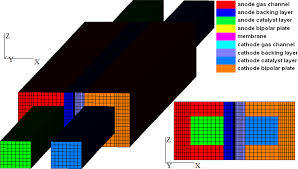
distinct components: the membrane electrode assembly (MEA) comprising a
proton conducting electrolyte membrane sandwiched between two catalyst
layers, the porous gas diffusion layers, and the bipolar plates with
embedded gas channels. In the anode catalyst layer, the hydrogen
oxidation reaction (HOR) splits the hydrogen into electrons, which are
transmitted via the external circuit, and protons, which migrate through
the membrane and participate in the oxygen reduction reaction (ORR) in
the cathode catalyst layer to recombine with oxygen and produce water
and waste heat.
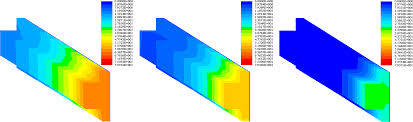
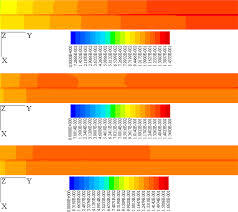
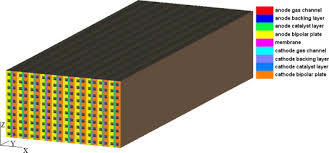
- Oxygen
concentration on the cathode side
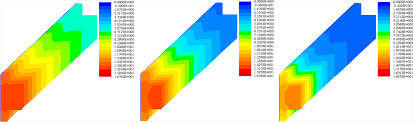
- Water concentration on
both sides
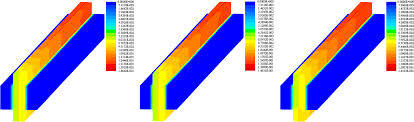
- Water distribution in MEA
on both sides
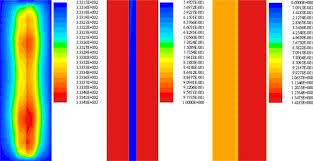
- Distributions of
temperature, protonic and electronic potentials
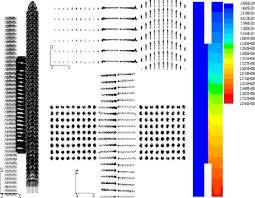
- Distributions of velocity
field and pressure
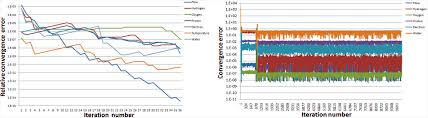
- Convergence history
with/without the advanced technique
|
A
Simplified Fuel Cell Model |
- We propose a model of liquid and heat
flux, ignoring the gas dynamics. More specifically we assume that
the pressure and vapour pressure are constant and solve for the
water volume fraction and the temperature as functions of space
and time. The water motion is driven by capillary pressure, and
a heat flux is generated by boundary conditions. The two equations
are coupled by condensation, which exchanges heat for liquid,
generating a liquid flux opposite that of the heat flux.
|
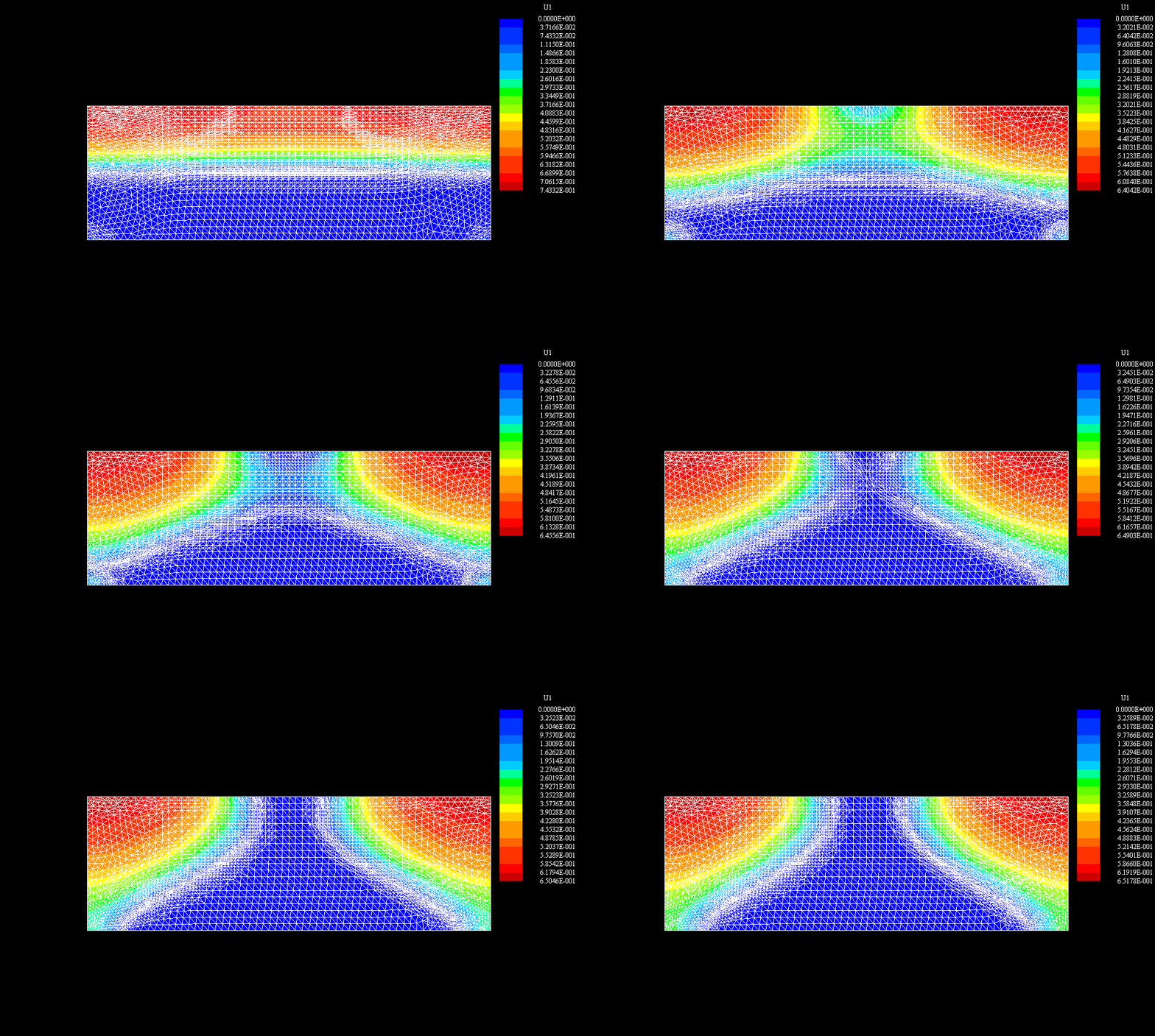
- Numerical simulation is done with the
adaptive finite element method
|
 |
|
|
|