
(1.1) Normal equation: A*Ax=A*b,
where, matrix A*A:
184.9198 182.5428 165.9724 122.5413
182.5428 273.5335 199.8720 157.2537
165.9724 199.8720 268.2798 216.0125
122.5413 157.2537 216.0125 232.1604
Matrix A*b:
98.0007
175.8608
182.8303
193.3366
(1.2) C-source code of Cholesky decomposition method:
#include "stdafx.h"
#include "math.h"
int _tmain(int argc, _TCHAR* argv[])
{
int i, j, k, m;
double aa[8][4]={7.0605, 9.5022, 4.4559, 1.19,
0.3183, 0.3445, 6.4631, 4.9836,
2.7692, 4.3874, 7.0936, 9.5974,
0.4617, 3.8156, 7.5469, 3.4039,
0.9713, 7.6552, 2.7603, 5.8527,
8.2346, 7.952, 6.797, 2.2381,
6.9483, 1.8687, 6.551, 7.5127,
3.171, 4.8976, 1.6261, 2.551};
double bb[8] = {0.7585,
0.5395,
5.3080,
7.7917,
9.3401,
1.2991,
5.6882,
4.6939};
double l[4][4];
double y[4];
double x[4];
double AC[4][4];
double ax[4];
double xx[4];
double at[4][8];
double a[4][4];
double b[4];
for(i = 0; i<4; i ++){
for(j = 0; j<8 ; j ++){
at[i][j]=0;
at[i][j]=aa[j][i];
}
}
for(i=0; i<4; i++){
for(j=0; j<4; j++){
a[i][j]=0;
for (k = 0; k<8; k++) {
a[i][j]+=at[i][k]*aa[k][j];
}
}
}
printf("Matrix At*A: \n");
for(i=0; i<4; i++){
for(j=0; j<4; j++){
printf(" %7.4f", a[i][j]);
}
printf("\n");
}
for(i=0; i<4; i++){
b[i]=0;
for (k = 0; k < 8; k++) {
b[i]+=at[i][k]*bb[k];
}
}
printf("Matrix At*b: \n");
for(i=0; i<4; i++){
printf(" %7.4f", b[i]);
printf("\n");
}
for (i = 0; i <4; i++){
for (j = 0; j <4; j++){
l[i][j]=0;
}
}
for (i = 0; i <4; i++){
y[i]=b[i];
}
for(i=0; i<4; i++){
for(j=0; j<4; j++){
AC[i][j]=0;
AC[i][j]=a[i][j];
}
}
/* Cholesky Decomposition */
for (k = 0; k < 4-1; k++){
l[k][k]=sqrt(a[k][k]);
for(m=k+1; m<4; m++){
l[m][k]=a[m][k]/l[k][k];
for(j=k+1; j<4; j++){
for(i=m; i<4; i++){
a[i][j]-=l[i][k]*l[j][k];
}
}
}
}
l[3][3]=sqrt(a[3][3]);
printf("Matrix B: \n");
for(i=0; i<4; i++){
for(j=0; j<4; j++){
printf(" %7.4f", l[i][j]);
}
printf("\n");
}
for (i = 0; i <4; i++) {
y[i] /= l[i][i];
for (j = 0; j <i; j++){
y[i] -= l[i][j] * y[j]/l[i][i];
}
}
for (i = 0; i <4; i++){
x[i]=y[i];
}
for (i =4-1; i >=0; i--) {
x[i] /= l[i][i];
for (j = i+1; j < 4; j++){
x[i] -= l[j][i] * x[j]/l[i][i];
}
}
printf("x= \n");
for(i=0; i<4; i++){
printf(" %7.4f", x[i]);
printf("\n");
}
for(i=0; i<4; i++){
ax[i]=0;
for (k = 0; k < 4; k++) {
ax[i]+=AC[i][k]*x[k];
}
}
for(i=0; i<4; i++){
xx[i]=ax[i]-b[i];
}
printf("At*Ax-At*b= \n");
for(i=0; i<4; i++){
printf(" %7.4f", xx[i]);
printf("\n");
}
return 0;
}
Using Cholesky decomposition method, we obtain A=BtB,
where, matrix B:
13.5985 0.0000 0.0000 0.0000
13.4237 9.6611 0.0000 0.0000
12.2052 3.7297 10.2666 0.0000
9.0114 3.7561 8.9629 7.5176
and the solution is
x=
-0.4958
0.5741
-0.0304
0.7339
We check the solution is right using the residual:
At*Ax-At*b=
0.0000
0.0000
-0.0000
0.0000
(2.1) Find the Householder
QR factorization for
First of all, we
find the
Householder matrix for the transformation of the first column vector x =  of A.
of A.
we compute  Choose
the sign plus for coefficient of
Choose
the sign plus for coefficient of  , and
we obtain
, and
we obtain 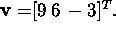 Find
the Householder
matrix H1 that depends only on direction of
v,
Find
the Householder
matrix H1 that depends only on direction of
v, 

Thus,

We can verify that 
To find  we compute the according Householder
vector: the first column vector of the (1,1)-minor of H1A:
we compute the according Householder
vector: the first column vector of the (1,1)-minor of H1A:
Hence 
and 
and also 

Find also the orthogonal matrix 

and check the result 
(2.2) Find the Householder
QR factorization of 
The vector that has to be transformed is  where
where  Construct the vector
Choose the sign minus for the coefficient of  and take into account that H depends only on the
direction of
and take into account that H depends only on the
direction of  :
: 
Find the Householder
matrix 

Verify that H1 annihilates all
the elements of the first column of A but the first one. Indeed, 
Further we transform the vector  the first column vector of the (1,1)-minor of H1A,
where
the first column vector of the (1,1)-minor of H1A,
where 
Find the Householder
vector according to 

Choose the sign minus for coefficient of : 
We obtain the
Householder matrix according to this vector 


and find that 
Thus, 
and 
Let us check the result: 